- The SEOs Diners Club
- Posts
- 🔥 SEOs Diners Club #214: Why AI Can't See You: AEO — The Science of Getting Your Content Into AI Responses
🔥 SEOs Diners Club #214: Why AI Can't See You: AEO — The Science of Getting Your Content Into AI Responses
AI search engines don't rank pages — they select fragments. According to research from Princeton, Carnegie Mellon, and the University of Toronto, AEO (Answer Engine Optimization) techniques can boost AI visibility by up to 40%. So how do you get your content into ChatGPT, Google AI Mode, and Perplexity responses? This week's headline: the science and practice of AEO.

Mert Erkal
March 30, 2026
Hey everyone!
A critical article for the SEO world dropped this week. Slobodan Manic's AEO (Answer Engine Optimization) guide on Search Engine Journal brings together research from Princeton, Carnegie Mellon, the University of Toronto, and Columbia under one roof. Regular readers of this newsletter know we've been discussing how to become visible in AI search for a while. This article grounds that discussion in hard data.
Meanwhile, Google crammed both a Spam Update and a Core Update into a single week, Marie Haynes called Google's new "Google-Agent" user agent and WebMCP protocol the biggest mindset shift in SEO history, ChatGPT crossed $100 million in ad revenue, and Shopify pushed 5.6 million stores into AI conversations.
Grab your coffee — this week is packed.
🎯 AEO — The Science of Getting Your Content Into AI Responses
First, Let's Clarify the Terms: SEO, AEO, and GEO
AEO stands for Answer Engine Optimization. The term emerged when Google began serving direct answers through Featured Snippets and Knowledge Panels. Its purpose: structuring your content so search engines and AI systems serve it as a direct answer to a query.
So what's the difference between AEO and GEO (Generative Engine Optimization)? Both target AI visibility, but their focus differs:
SEO (Search Engine Optimization): Ranking in traditional search engines. Keywords, backlinks, technical infrastructure. Click-focused.
AEO (Answer Engine Optimization): Becoming the "selected answer" on platforms that provide direct responses — Google AI Overviews, Featured Snippets, People Also Ask boxes, and voice search. Focused on short, clear, extractable answers. Aims to be the best answer to specific questions.
GEO (Generative Engine Optimization): Getting cited in responses generated by large language models like ChatGPT, Claude, Perplexity, and Gemini. Focused on being shown as a source for comprehensive topics. Brand authority, third-party mentions, and entity richness are critical.
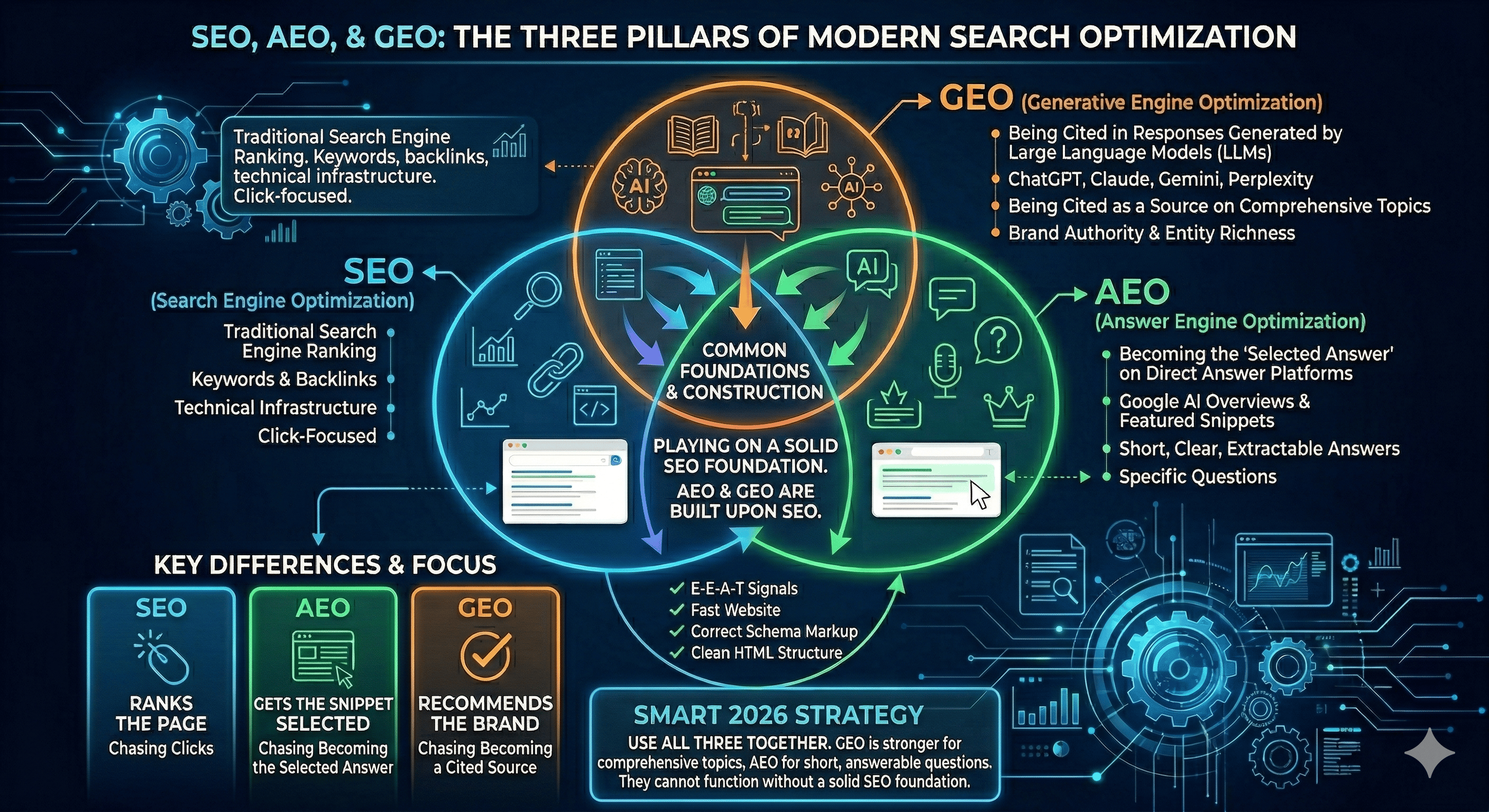
What they share: all three sit on top of solid technical SEO. Fast site, correct schema markup, clean HTML structure, E-E-A-T signals — these form the shared foundation. AEO and GEO don't replace SEO; they build on top of it.
How they differ: SEO chases clicks, AEO chases being the selected answer, GEO chases being the cited source. SEO gets your page ranked, AEO gets your fragment selected, GEO gets your brand recommended.
A smart 2026 strategy uses all three. GEO is more effective for comprehensive topics; AEO is stronger for short, answerable questions. But neither works without a solid SEO foundation.
The Core Truth: AI Doesn't Rank Pages — It Selects Fragments
Slobodan Manic's comprehensive AEO guide on Search Engine Journal lays out the fundamental difference between AI search and traditional search with data.
Traditional search ranks pages. AI search does something fundamentally different. Microsoft's Krishna Madhavan from the Bing team explains it: AI assistants break content down into smaller, structured pieces (parsing), evaluate each piece for authority and relevance, then assemble selected pieces from multiple sources into a single coherent response.
This is a crucial distinction. Your page might rank #1 on Google and still never get cited in AI responses. Why? Because your content isn't structured into fragments that AI can extract and use.
The numbers show the scale of the shift. According to Conductor's January 2026 AEO/GEO Benchmarks Report (13,770 domains, 17 million AI responses analyzed), AI traffic accounts for 1.08% of all website sessions and is growing roughly 1% month over month. Sounds small, but think compounding. Microsoft reported that AI referrals spiked 357% year-over-year in June 2025, reaching 1.13 billion visits. One in four Google searches now triggers an AI Overview. In healthcare, it's nearly one in two. That content has to come from somewhere. The question is whether it comes from you.
What the Research Says: The Science of Getting Cited
Manic's article chronologically summarizes the academic research on AEO. Here are the most striking findings:
Princeton, IIT Delhi, and Georgia Tech (GEO, KDD 2024): Nine optimization strategies tested. GEO techniques boosted AI visibility by up to 40%. The most effective single technique: citing credible sources — which alone produced a 115.1% visibility increase for sites not already ranking in top positions. Counterintuitively, writing in an authoritative or persuasive tone did not improve AI visibility. AI systems respond to verifiable information, not rhetorical style.
University of Toronto study (September 2025): The first large-scale comparative analysis across ChatGPT, Perplexity, Gemini, and Claude. Most striking finding: AI search overwhelmingly favors earned media. In consumer electronics, AI cited third-party authoritative sources 92.1% of the time vs. Google's 54.1%. Automotive: 81.9% vs. 45.1%. It's not just how you write — it's which domain your content appears on. Press coverage, independent product reviews, and mentions on industry publications carry far more weight than your own website.
Carnegie Mellon AutoGEO study (October 2025): Used automated methods to discover what generative engines actually prefer. Results: up to 50.99% improvement over best baseline. Universal preferences emerged across engines: comprehensive topic coverage, factual accuracy with citations, clear logical structure with headings and lists, and direct answers to queries.
GEO-16 framework (September 2025): Analyzed 1,702 real citations from Brave, Google AI Overviews, and Perplexity. Identified 16 on-page quality factors that predict citation likelihood. Top three: metadata and freshness, semantic HTML, and structured data. Technical on-page factors matter as much as writing quality.
Columbia and MIT e-commerce study (November 2025): A reality check. Of 15 common content rewriting heuristics, 10 produced negligible or negative results. The strategies that worked converged toward truthfulness, user intent alignment, and competitive differentiation. Not tricks — substance.
The common message across all research: AI systems reward clarity, factual accuracy, and structure. They don't reward marketing language, persuasion tactics, or keyword density.
Content Structure That Earns AI Citations
Manic's article draws from official guidance by Microsoft and Google to outline what makes content structurally citable:
Heading hierarchy matters more than ever. Each H2 and H3 heading should cover one specific idea. In Microsoft's words: strong headings are signals that help AI know where a complete idea starts and ends. Vague headings like "Learn More" or "Overview" give AI nothing to work with. A heading like "How AI engines process content differently from search engines" tells the system exactly what the section contains.
Q&A format is native to AI. Write questions as headings with direct answers below. Microsoft's note: AI assistants can often lift these pairs nearly word-for-word into their responses. If your content answers the question someone asks an AI, and it's structured as a clear question-answer pair, you've made the AI's job easy.
Make your content "snippable." Bulleted and numbered lists, comparison tables, step-by-step instructions. These formats give AI clean, extractable fragments. A paragraph buried in a wall of text is much harder for AI to isolate than the same information presented as a three-item list.
Front-load the answer (BLUF). Start sections with the key information, then provide context. If someone asks "What temperature should I bake bread at?" and your content opens with two paragraphs of bread history before mentioning 375°F, you'll lose the citation to a competitor who leads with the answer.
Make each section self-contained. AI extracts fragments. If your fragment only makes sense in the context of the whole page, it won't be selected.
Critical technical note from Microsoft: Don't hide important answers in tabs or expandable menus. AI systems may not render hidden content. FAQ answers collapsed inside an accordion, product specs behind tabs, content that requires interaction to reveal — all of these may be invisible to AI. If information is important, it needs to be in the visible HTML.
Google vs. Microsoft: Two Philosophies
A striking contrast in Manic's article. Google says: just do good SEO. Their official documentation is deliberately minimalist. Microsoft says: here's the playbook. Their October 2025 blog posts and January 2026 guides provide detailed, actionable guidance — specific heading structures, schema recommendations, content formatting rules, concrete examples.
The difference is partly market position. Google dominates search and has less incentive to help publishers optimize for AI features that might reduce clicks. Microsoft, with roughly 8% market share, benefits from giving publishers reasons to optimize specifically for their ecosystem.
But here's the practical takeaway: Microsoft's guidance isn't Bing-specific. Structured content, clear headings, snippable formats, schema markup, and expert authority are universal principles. Following Microsoft's playbook improves your content for every AI system — including Google's. Google just won't tell you that.
Schema Markup: From Text to Knowledge
Microsoft describes schema as code that "turns plain text into structured data that machines can interpret with confidence." Krishna Madhavan reinforced this at Pubcon: "Schemas are super useful. They help the system discern exactly what your information is without us having to guess."
The GEO-16 framework confirms this from the academic side: structured data is one of the top three factors predicting AI citation likelihood.
The most critical schema types for AI visibility: FAQPage (maps directly to how AI formats responses), HowTo (step-by-step instructions), Product with Offer, AggregateRating, and Review (e-commerce), Article/BlogPosting (content with clear authorship and dates), and Organization (business identity). Pair structured data with IndexNow: IndexNow tells search engines that something has changed, while structured data tells them what has changed.
E-E-A-T for AI
E-E-A-T (Experience, Expertise, Authoritativeness, Trustworthiness) isn't just a Google concept anymore — it's what AI systems across the board look for. But there's a critical nuance: the original GEO research found that writing in a persuasive or authoritative tone did not improve AI visibility. Facts and cited sources did. Marketing language doesn't impress algorithms.
Combine this with the University of Toronto finding: AI systems trust third-party validation over self-promotion. That 92.1% third-party source preference rate speaks for itself. Getting your expertise published on industry websites, earning press coverage, and building a presence on authoritative platforms is more effective for AI visibility than perfecting the copy on your own site.
Freshness is a signal, not a bonus. Krishna Madhavan made this clear at Pubcon: stale or missing content constrains the amount of retrieval AI systems can do and pushes agents toward alternative sources.
Mert's Take: "How Do I Rank?" Has Been Replaced by "How Do I Get Selected?"
If I had to boil down the core message of this article to a single sentence: traditional SEO asked "How do I rank?" AEO asks "How do I become the fragment that gets selected?"
The answer isn't a single trick. It's clear structure, verifiable expertise, and content that AI can confidently extract and cite. Moving away from persuasive tone, marketing jargon, and keyword density. Moving toward facts, source attribution, and structural clarity.
Last week I said "personalization + ads = the end of many SEO strategies." This week I'm adding a third dimension: if your content isn't extractable, verifiable, and citable by AI, you're getting hit with a triple blow alongside personalization and ads.
🔥 Google-Agent and WebMCP: The Biggest Mindset Shift in SEO History
Marie Haynes' analysis on Search Engine Journal is this week's second biggest story. Google announced a new user agent called "Google-Agent" this week. When AI agents using Google's infrastructure (like Project Mariner) visit your site, they'll use this new tag.
But the truly disruptive part isn't the user agent — it's the protocol behind it: WebMCP.
The Agentic Web: What Happens When Humans Stop Clicking?
In Haynes' words: the web where humans click links and scroll pages is radically ending. What replaces it is the agentic web. Google's Head of Search Liz Reid confirmed this in a recent interview: people will still want to hear from other people, but we're likely headed to a world where many agents are talking with each other.
Understanding the business impact of the protocols Google outlined this week is critical:
MCP (Model Context Protocol): Lets AI agents securely access your backend data.
A2A (Agent2Agent): Enables bot-to-bot communication and transactions.
UCP (Universal Commerce Protocol): Lets a machine buy your product directly from the SERPs.
A2UI (Agent to User Interface): Automatically composes new visual layouts for users.
WebMCP: Agents Will Use Your Site Like Machines, Not Humans
Standard browser agents are slow because they look at pixels like humans do. WebMCP lets agents use the functionality of your website in real time, natively.
The obvious use case: an AI agent filling out your lead forms automatically and perfectly. But Haynes envisions far more interesting scenarios: a world where you can publish your own AI agents, where other people's agents can access your agents via WebMCP, negotiate pricing, and even help each other improve.
If you're in e-commerce, keep a close eye on UCP. Google's Nick Fox summed it up: "Search is becoming AI Search, and the Gemini app is your personal assistant." Google is increasingly seeing AI Mode and AI Overviews as one and the same.
Mert's Take: This Isn't Scary — It's Exciting
The most accurate observation in Haynes' article: this transition might sound terrifying if you rely solely on traditional keyword rankings. In reality, it's the biggest opportunity we've seen since the invention of the search engine itself.
WebMCP and UCP mean we're no longer just optimizing for clicks — we're optimizing for direct action, frictionless commerce, and automated lead generation. The partnership between content creators and Google has definitively changed. But the future of what we can build on this agentic web is incredibly bright.
Haynes' advice is clear: familiarize yourself with WebMCP, learn UCP if you're in e-commerce, start experimenting with vibe coding using AI tools. No one knows exactly how the future will unfold, but those who invest in learning AI will have a massive advantage.
🔄 Algorithm & Search Engine Updates
Google Fires Twice in One Week
Google went all in this week. The March 2026 Spam Update launched on March 24 and completed in record time — 19.5 hours. Confirmed done on March 25. Two days later, the March 2026 Core Update began rolling out on March 27. This is the first broad core update of 2026. Global, all languages and regions. May take up to two weeks to complete.
Two updates back-to-back isn't a coincidence. The Spam Update cleans out low-quality content, then the Core Update redefines what "quality content" means. Wait at least a full week after completion before analyzing your Search Console data.
Google Tests Massive Citation Cards in AI Overviews
Google is testing large citation cards placed beneath AI Overviews. Citations that normally appear as small links on the right side are now being shown as large blue cards below the summary — with thumbnails, favicons, site names, titles, and descriptions. Reminiscent of the SGE era. If this format sticks, the click value of being cited in AI Overviews could increase significantly.
Bing Adds Page-Level Query Mapping to AI Reports
Bing Webmaster Tools added grounding query and page mapping to its AI Performance report. You can now see which AI queries are citing which of your pages. Google Search Console's AI Mode performance report is currently available only in the US, but Bing's report is global. Evaluated together, these create the first concrete data sources for your AI search visibility. If you haven't started tracking these reports, start today.
🛒 Big Moves in AI Commerce: Shopify In, OpenAI Out
Shopify Agentic Storefronts: 5.6 Million Stores Inside AI Conversations
Shopify rolled out Agentic Storefronts to all stores. 5.6 million Shopify stores are now automatically discoverable in ChatGPT, Google AI Mode, Microsoft Copilot, and the Gemini app. No app install, no integration, no additional transaction fees.
The numbers are impressive: AI-referred traffic to Shopify is up 7x since January 2025. AI-attributed orders are up 11x. With ChatGPT's 880 million monthly active users, this is a serious distribution channel.
Critical detail: purchases are completed on the merchant's own storefront, not inside ChatGPT. In-app browser on mobile, new tab on desktop.
OpenAI Retreats from Instant Checkout
OpenAI shut down its ChatGPT Instant Checkout feature. Launched with big ambitions in January 2026, it allowed users to buy directly within the chat. But according to TechCrunch, OpenAI struggled with merchant onboarding, failed to show accurate product data, and hadn't even built a US state sales tax collection system.
The new strategy: purchases happen through ChatGPT Apps, within connected services. Target, Sephora, and Nordstrom already support the new product discovery experience. Product discovery in AI conversations is here to stay, but the purchase still happens on your website. Your site's conversion optimization is more critical than ever.
🤖 From the AI World
ChatGPT Hits $100 Million in Ad Revenue
OpenAI announced that ChatGPT's annualized ad revenue has surpassed $100 million. And that number came just six weeks after the ad pilot launched. Less than 20% of eligible users currently see ads. Over 600 advertisers are now on the platform.
The real news: self-serve advertiser access is on track to launch in April. This means ChatGPT ads are leaving the managed-pilot-for-big-brands phase and opening up to everyone. Geographic expansion into Canada, Australia, and New Zealand is being explored. OpenAI hired former Meta ad executive Dave Dugan to lead ad sales.
Last week I discussed Google AI Mode turning into an ad machine. Now ChatGPT is on the same path and moving fast. The concept of "ad-free organic space" in AI search is shrinking on both platforms.
55% of Marketers Are Now Allocating Budget to GEO
According to current research data, 55% of marketers have started carving out GEO (Generative Engine Optimization) budgets from their SEO spend. Given that 93% of AI search sessions end without a single click to a website, this percentage will keep rising. Those still categorizing GEO as "experimental" are falling behind.
Gemini 3 Becomes the Default Model for AI Overviews
Google made Gemini 3 the default model for AI Overviews globally. Users can now ask follow-up questions directly from an AI Overview, jumping straight into AI Mode. This is a significant step toward AI Mode becoming a natural part of the search experience rather than a separate feature.
Google Search Console Adds AI Mode Performance Tracking (US Only for Now)
Google added an AI Mode-specific performance filter to Search Console. The new "Search appearance" filter lets you separate AI Mode clicks and impressions from traditional organic traffic. More importantly: you can see how often your pages are shown as sources in AI Mode summaries, even when users don't click. Important note: this feature is currently available only for US users and US search data. No timeline from Google for global rollout yet.
🔧 Actionable SEO Tips
1. Structure your content for AEO. Every section should be self-contained and extractable. Use specific descriptions in headings instead of vague phrases ("Learn More"). Front-load the answer (BLUF). Don't hide FAQ content behind accordions or tabs.
2. Enrich your schema markup. Implement FAQPage, HowTo, Product, Article/BlogPosting, and Organization schemas. Pair with IndexNow for freshness signals.
3. Launch your third-party mention strategy. University of Toronto data shows AI trusts third-party sources at rates up to 92%. PR, guest articles, contributions to industry reports, and press coverage directly impact your AI visibility.
4. Don't panic during the Core Update — observe. The March 2026 Core Update won't finish until around April 10. Don't make major changes until it completes. Wait at least a week after completion before analyzing Search Console data.
5. Get familiar with WebMCP and UCP protocols. Marie Haynes' analysis shows the web is shifting from human clicks to machine interactions. If you're in e-commerce, track UCP closely. If you have lead forms, watch WebMCP.
6. Check Bing's AI Performance report. Grounding query and page mapping shows which of your pages are being cited by AI. GSC's AI Mode report is US-only for now, but Bing's is global and free.
7. If you're on Shopify, verify Agentic Storefronts. Your products should be automatically visible in ChatGPT and AI Mode. Verify from your Shopify Admin. Make sure your product feeds and schema markup are complete.
👋 Closing
This week's picture is crystal clear: the AI search world has shifted from "page ranking" logic to "fragment selection" logic. If your content can't be confidently extracted, verified, and cited by AI, your risk of invisibility grows every day.
AEO research provides hard data: citing credible sources yields a 115% visibility boost, AI prefers third-party sources at a 92% rate, persuasive tone has zero effect. Google-Agent and WebMCP show the web is evolving from human clicks to machine interactions. ChatGPT's $100 million in ad revenue in just six weeks reveals the economic dimension of this new world.
Last week I said "personalization + ads = the end of many SEO strategies." This week I'm adding new dimensions: AEO-optimized content structure + third-party credibility + agentic web readiness = the 2026 survival formula.
If you want to adapt your SEO and GEO strategy to this new reality, we at Stradiji are happy to help.
Until next week with more updates — take care of yourselves!
Mert Erkal
Stradiji | SEO, GEO & Conversion Optimization
Support the newsletter: if you find this content useful, buy me a coffee. ☕
About Mert Erkal Founder of Stradiji. 15+ years in SEO and GEO consulting for corporate clients globally. Author of SEOs Diners Club (English) and Dijital Pazarlama Notları (Turkish).
Newsletter: seosdinersclub.beehiiv.com
Twitter: twitter.com/merterkal
LinkedIn: linkedin.com/in/merterkal
YouTube: youtube.com/@stradiji